Sunday, 21 October 2012

Tongue Twisters? Why?


TWO LIPS
“The flexibility of the lips is very important if speech is to be clear and projected. Vowels as well as consonants suffer from lack of lip mobility.” Sounds: p  b  m  w  wh

Peter Piper picked a peck of pickled peppers
A peck of pickled peppers Peter Piper picked
If Peter Piper picked a peck of pickled peppers
Where’s the Peck of pickled peppers Peter Piper picked?

A white witch watched a woe-begone walrus winding white wool

A poor pauper paused on purpose to pawn a porpoise

Big blue blisters bleeding badly

Which witch is which?


TONGUE-TIP AND UPPER-TEETH RIDGE
“The majority of English consonants are produced by approximation of the tongue-tip and upper-teeth ridge” Sounds: t  d  l  n  r  s  z

Six Sicilian seamen sailed the seven seas southward

Do drop in at the dew drop inn

Christopher Twistle was trying to whistle and Christopher twisted his tongue

Red lorry, yellow lorry, red lorry, yellow lorry

Twenty twisted tangled threads, twining taut the tree tops


BACK OF  TONGUE AND SOFT PALATE
“These help those people who find it difficult to pronounce the ‘ing’ on the ends of words such as ‘singing’ and ‘ringing’. It will also help those who suffer from nasality caused by a lazy soft palate” Sounds: k  g  ng

A skunk sat on a stump
The skunk thunk the stump stunk
The stump thunk the skunk stunk

How much caramel
Can a canny cannibal
Cram into a camel,
If a canny cannibal
Can cram caramel
Into a camel?
                                                                              
Quin’s twin sisters sing tongue-twisters

Three grey green greedy geese,
Feeding on a weedy piece,
The piece was weedy,
And the geese were greedy,
Three grey green greedy geese.


TONGUE-TIP AND UPPER TEETH
“Many people have difficulty with the ‘th’ sound in ‘think’ and ‘thought’. ‘Cockneys’ tend to pronounce these words as ‘fink’ and ‘fought’. These will help in correcting this” Sounds: th 

Freddy thrush flies through thick fog

I’d far rather lather father,
Thank father lather me,
Because when father lathers,
He lathers rather free

The Leith police dismisseth us

Whether the weather be fine
Or whether the weather be not
Whether the weather be cold
Or whether the weather be hot
We’ll weather the weather,
Whether we like it or not.

This thatched roof is thick
TONGUE-TIP AND UPPER TEETH
“Many people have difficulty with the ‘th’ sound in ‘think’ and ‘thought’. ‘Cockneys’ tend to pronounce these words as ‘fink’ and ‘fought’. These will help in correcting this” Sounds: th 

Freddy thrush flies through thick fog

I’d far rather lather father,
Thank father lather me,
Because when father lathers,
He lathers rather free

The Leith police dismisseth us

Whether the weather be fine
Or whether the weather be not
Whether the weather be cold
Or whether the weather be hot
We’ll weather the weather,
Whether we like it or not.

This thatched roof is thick

LOWER LIP AND UPPER TEETH
“If you trip over your ‘f’ and ‘v’ consonants then practice these amusing ‘twisters’,” Sounds: f  v

Five frantic frogs fled from fifty fierce fishes.

One smart fellow he felt smart
Two smart fellows they felt smart
Three smart fellows they all felt smart

A fat-thighed freak fries thick fish

I’m a fig plucker,
I’m a fig plucker’s son
I pluck figs till the fig pluckers come.

Vera valued the valley violets

Vigorous Vesta voiced voluble verse vociferously

TONGUE BLADE AND FRONT OF HARD PALATE
“These contain some of the sounds which trip many tongues. ‘sh’ and ‘s’ placed closely together are well-known hazards.” Sounds: ch  ge  sh  zh

A chilly sited click steel slitter sitting slitting a satellite’s charted site.

Chin-chin chinaman. Chop! Chop! Chop!

If a shipshape ship shop stocks six shipshape shop-soiled ships
How many shipshape shop-soiled ships would six shipshape ship shops stock

Once I hear a mother utter,
‘Daughter. Go and shut the shutter.’
‘Shutter’s shut,’ the daughter uttered.
‘For I can’t shut it any shutter’

The Duke paid the money due to the Jew before
The dew was off the grass on Tuesday
And the Jew having duly acknowledged it
said adieu to the Duke for ever.

OPEN RESONATOR
“’h’ is possibly the greatest single trouble-maker in speaking…I heard a nervous person drop the following verbal clanger: ‘Hi ope that you will support the harts in this harea.’ You can avoid a similar incident if you practise these examples” Sounds: h

He ate hot apples and halibut hastily

A haddock, a haddock, a black-spotted haddock,
A black spot on the black back of a black-spotted haddock.

If a hair net could net hair,
How much hair could that hair net net,
If a hair net could net hair?

Last year I could not hear with either ear

If a Hottentot taught a Hottentot to to talk ere the tot could totter,
Ought the Hottentot tot to be taught to say ‘ought’ or ‘naught’
Or what ought to be taught her?

-Exaggeration of vowels
-Thai Chi
-Lateral stretching
-Breathing in then breathing out with ‘colour’ e.g. “eeee” “aaah” “oooh”
-Humming

“ The voice is the means by which, in everyday life, you communicate with other people, and though, of course, how you present yourself-you posture, movement, dress and involuntary gesture-gives an impression of your personality, it is through the speaking voice that you convey your thoughts and feelings.”

This quote from Cicely Berry shows us that it is vital that we look after our voice and emphasizes the importance of maintaining healthy vocal chords. Some exercises that were widely popular amongst my peers were the tongue twisters. Tongue twisters have been used all over the world, by many different performers for years. This is because it so influential on articulation, diction, clarity and sibilance, amongst others.

Me doing some tongue twisters:

http://picosong.com/wMep

The tongue twisters I practiced were very, very helpful. They really helped with articulation, diction, clarity and sibilance as well as exercising various muscles in the body to help with our muscular control. They are exercises that can be used in a variety of situations and will help us throughout the course as well as any other performing routes we decide to take. The different tongue twisters focused on different parts of our voice; some focused on the pronunciation, lips and tongue whilst others focused on the guttural part of our voice. I found that the main problem I have with my articulation and pronunciation is controlling where my tongue is in the mouth, so placing it correctly. Because of this I plan to work a lot on particular tongue twisters that focus on helping with that specific problem. I know that this is not just an eay fix so I will continue to work on this to persistently improve my diction.

I am focusing on particular one such as:

Whether the weather be fine
Or whether the weather be not
Whether the weather be cold
Or whether the weather be hot
We’ll weather the weather,
Whether we like it or not.

Three grey green greedy geese,
Feeding on a weedy piece,
The piece was weedy,
And the geese were greedy,
Three grey green greedy geese.

Christopher Twistle was trying to whistle and Christopher twisted his tongue

More of me practicing the above specific tongue twisters: http://picosong.com/wMCC


EXERCISES FOR THE TONGUE:
·         Twist the Twine Tightly Round the Tree Trunks
·         Did Dora Dare to Deceive David Deliberately?
·         Kate Cooney Carefully Closed the Kitchen Cupboards
·         Gregory Garside Gained Good Gradings in Greek Grammar
·         Naughty Nora Has No Nice Neighbours
·         Little Larry Lester Lolled Lazily on the Li-Lo
·         Rosemary Wright Was Richly Dressed in Red Corduroy
“Exercising the back of the tongue is vital, not only for clarity of diction, but for the release of the sound as a whole.”


I am going to continue practicing these articulation exercise throughout the entirety of the course as well as during my time as a performer. Looking at my vocal skills from this angle really helps me to highlight what I need to work on in order to make the most out of my tool so that I can improve and develop.




Personal Warm-Up Practice


 My personal preparation for singing was to extend my vocal range with the use of various exercises:

·         Breathing and breath control to relax and remove all tension
·         Big Mouth
·         Big Mouth with silent scream
·         Cat’s Bum
·         Cat’s Bum with silent scream
·         Sirening – (mmm, oooh, woahh, ahhh)
·         “A, E, I, O, U”
·         “A, E, I, O, U”– raising octave
·         “Ah, Ay, Eee, Oh, Ooh”
·          “Ah, Ay, Eee, Oh, Ooh”– raising octave
·         Tongue twisters
·         “mmmm” – resonator not scales
·         “ooooh” – resonator
·         “woahh” – resonator
·         “ahhh” – resonator
·         “Sh, sh, sh, sh”
·         “Tss, tss, tss, tss”
·         “Pft, pft”
·         “Ha, ha, ha, ha, ha” – exaggerated laughing, with my hands on my diaphragm so I could feel the movement and contractions of it.
·         “Huh, huh, huh, huh” – with my hands on my diaphragm so I could feel the movement and contractions of it.
·          “A-men”
·         I then worked on some Tongue Twisters.
·         Next I began some staccatos first with the sound of ‘la’. I had to ensure that I relaxed my jaw and I began lowering and ascending in octaves as I went along. I then repeated this exercise but this time with the sound of ‘nan a nan a nan a nan a na’ then ‘nah nah nah’. To exercise and strengthen my jaw and upper palate I then made the sound ‘nya nya nya nya nya’. I then stretched out various other facial muscles by making the sound ‘maw maw maw’ ensuring that my lips were pursed creating a ‘fish’ face.
·         I then exercised our soft palate: ‘yah-e-ah yah-e-ah yah-e-ah yah-e-ah yah-e-ah yah-e-ah yah-e-ah yaaaahh’ with this exercise I raised octaves as I went along and as well as for me to exercise my soft palate it helped with my vibrato.
·       ‘yah yah yah yah yaaah, yah yah yah yah yaaah, yah yah yah yah yaaah, yaaah’, ‘la la la la laaah, la la la la laaah, la la la la laaah, laaah’ and ‘mm mm mm mm mmmm, mm mm mm mm mmmm, mm mm mm mm mmmm, mmmm’ – I lowered in octaves

I I still struggle with my pitching  but with practice I have managed to improve my range and have been, on 1 or 2 occasions been actually able to reach a C#, my problem is with my transition between my chest voice and my head voice. Knowing that this is my current problem I plan to continue doing various vocal exercises such as sirening and arpeggios to smooth over my vocal transitions. 

Monday, 8 October 2012

The Lungs

The Lungs


The lungs are the most essential organ when it comes to respiration. The lung’s primary function is to transport oxygen from the general atmosphere, into the blood stream and then throughout the different areas of the body. It is also the role of the lungs to then remove any carbon dioxide from the blood stream and then release it back into the atmosphere. The lungs are a pair of sponge-like organs and are found in the thoracic cavity, almost filling it. They have many folds which increase the surface area for gas exchange and your left lung is slightly smaller than your right lung. This is so that there is space in the thoracic cavity for your heart.

The left lung is divided into two ‘lobes’ whilst the right lung is divided into three ‘lobes’.

Within your lungs there are two wind-pipes that divide off of the larger wind-pipe known as the trachea. These smaller wind-pipes are called the right stem and left stem bronchus; this of course means that the right stem bronchus leads into the right lung whilst the left stem bronchus leads into the left lung. From this point, the bronchus divide off into many smaller tubes called bronchi, which in turn divide off into even smaller tubes called bronchioles. There are a total of 22 divisions which leads to the forming of more than 100, 000 of these smaller tubes as well as more than 300 million tiny air sacs known as the alveoli. The alveoli are generally no more than 0.3mm in diameter.

The alveoli give the lungs an expansive surface area for gas exchange. The surface area of the lungs is so huge that if you were to lay all airways and air sacs of a person’s lungs, flat onto the ground, the surface area would cover an entire tennis court – more than 100 square yards.

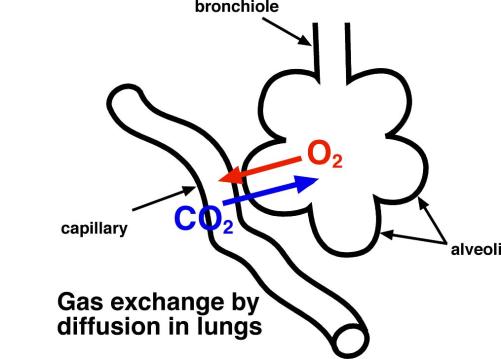
The alveoli are the most important part of our lungs as it is through them that all of the gasses diffuse in and out of your lungs into or out of your blood stream. This is possible as the alveoli are totally covered and ‘bathed’ in millions of minute blood capillaries. The alveoli allow for an efficient of exchange of oxygen into the blood stream and carbon dioxide out of the blood stream and back into the lungs ready to be exhaled back into the atmosphere.
Obviously the lungs are the pushing power that allows for respiration. The air we breathe in travels down our trachea (windpipe), into the lungs through the two bronchus and the oxygen from this is then dispersed into the blood stream with thanks to the alveoli. With each breath we take, the lungs draw in oxygen and remove carbon dioxide.
The alveoli have a very thin membrane which allows for the exchange of gases but if this membrane thickens or is damaged even slightly, the vital gas exchange becomes much less efficient. The more of a person’s alveoli that become damaged like this the higher the chance of said person suffering from breathlessness.

This would be a huge problem to a performer as a lack in the proficiency of the gas exchange can lead to breathlessness which would have a detrimental effect upon projection. The person may also begin to suffer with fatigue which can easily lead to problems such as fainting, which is not only dangerous for the sufferer but to the people around them when performing as fainting can easily cause accidents and injury. A person’s articulation may also become affected as fatigue can lead to a loss of focus and an increase in sloppiness. It is very important for me to have an understanding of how our lungs affect our voice in order for me to learn the importance and look after them in the aim to increase our breath control and vocal technique.
 
There are a numerous amount of diseases that can affect the health of our lungs and hinder our performance, for this reason it is very important for us to try our hardest to keep our lungs as healthy as possible. Some of the diseases that affect lung health include:
* Lung Cancer
* Asbestosis
* COPD (chronic obstructive pulmonary disease)
* Pneumonia
* Pleural cavity diseases
* Pulmonary vascular diseases
* Pulmonary Oedema
* Pulmonary tuberculosis
* Asthma
* Bronchitis

As well as the lungs being the main organ necessary for respiration, they actually also act as one of the body’s defences against infection and harmful bacteria. Despite the fact that the nose is the primary line of defence against harmful materials that are inhaled, the lungs count as the secondary line of defence, any harmful inhaled particles, such as smoke and pollution, and infectious agents, such as many viruses and bacteria, pass through our nose or mouth and proceed to lodge in the lungs.

The lungs produce a sticky substance called mucous and it is this fluid that can trap these inhaled materials and therefore aid the lungs’ white blood cells in the process of destroying these harmful agents and bacteria. It is suggested to cough as a good way to clear mucus from the lungs but these agents can be brough up the airways ready to be either swallowed of coughed out by cilia. The larger airways of our respiration system are covered with tiny cells that are almost hair-like called cilia.

These cells beat and it is their beating with a fast rhythm that allows the mucus and cells to be propelled up the airways to be coughed out or swallowed. It is often found that, in smokers, the cilia have been either killed or become inactive which allows thick mucus to accumulate resulting in an inefficient lung defence.

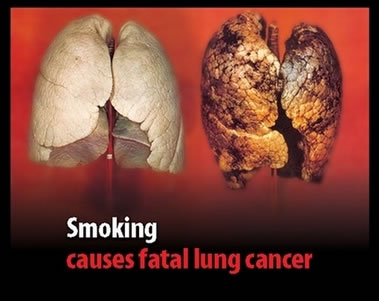
It is very important for performers to have as large a lung capacity as possible in order to enhance their vocal capacity through way of breath. There are factors that can serious affect and diminish your lung capacity. For example, if you smoke or suffer from lung disease your lung capacity is decreased. For performers, a decreased lung capacity can result in an incline of difficulty of holding a note for a long time (singing) or struggle with pronunciation and articulation due to a struggle to create the necessary glottal onset of vowels. I, personally am a smoker and therefore need to realise the damage smoking causes to my vocal health. Through way of research and disturbing pictures as above I hope to try and quit as i know that it is vital for a performer to have a healthy, working body in order to be the best that we can be.


The Intercostal Muscles

The Intercostal Muscles:

There are spaces present in-between the ribs and these are known as the intercostal spaces. Due to the fact that there are 12 ribs, there are 11 intercostal spaces and these spaces contain different nerves, blood vessels and muscles. The muscles that tend to be found in these gaps are the intercostal muscles.

The intercostal muscles are various collections of muscles that help to form and move the chest wall and can be found running between the ribs. There are three principal layers:

* The external intercostal muscles – these are on the outer layer. These originate on ribs 1-11 and their insertions are on ribs 2-12. These muscles aid in forced and quiet inhalation and are responsible for the expansion of the transverse dimension of the thoracic cavity as well as the elevation of the ribs. They are innervated by the intercostal nerves and provided by the intercostal veins and arteries, with their fibres running in opposite directions.

* The internal intercostal muscles – these are on the inner layer. These originate on ribs 1-11 and their insertions are on ribs 2-12. These muscles ain in forced expiration and are responsible for decreasing the transverse dimensions of the thoracic cavity as well as the depression of the ribs. They are innervated by the intercostal nerves and provided by the intercostal veins and arteries, with their fibres running in opposite directions.

* The innermost intercostal muscle – this muscle is found in the deepest layers of the internal intercostal muscles but is separated from them by the ‘neurovascular bundle’.


The left side of the picture shows the inner layer of the intercostal muscles whilst the right side shows the outer layer.

The main involvement of the intercostal muscles in with the mechanical aspect of breathing as they help in expanding and shrinking the capacity of the chest when breathing.
External: These muscles create an increased lung volume by pulling the ribs up and therefore draw air into the lungs. Internal: These muscles create a decreased lung volume by bringing the ribs closer to one another expelling the air out of the lungs.

These muscles aiding with the respiration process it what makes them so important to a performer. It is the usage of these muscles that enhance proper breathing and makes it possible for a reduction of strain on the vocal cords. They also help for greater breath control. Both of these are needed in both singing and acting, for example performing a monologue or when singing a song. My understanding of these muscles is important as to ensure that I look after my body and understand how to control them in order to improve my vocal technique.

Monday, 1 October 2012

Vocal Register and pitch

Vocal Register and Pitch
In order to fully understand the mechanisms of pitch control we must take a look at the composition of tissue in the vocal chords.


However, deeper vocal fold tissues - collagen, elastin and muscle - exhibit some resistance to stretching, but can become quite stiff.
A vocal register is a specific series of tones in the human voice that are produced as a result of one particular vibratory pattern of the vocal folds.
A person’s vocal pitch is determined by the resonant frequency of the vocal folds and differentiates with gender and age.

                                             
Average Frequency
Adult Male
125 Hz
Adult Female
210 Hz
Children
Over 300 Hz


The greater the frequency of vibrations in the vocal folds, the higher the vocal pitch will be and vice versa. A person’s vocal frequency is determined by the thickness and length of the vocal cords as well as the tension retained in the vocal cords. Due to this, women’s voices tend to be pitched higher than men’s as they have shorter vocal cords.
The movement of the vocal folds is controlled by what is known as the vagus nerve, which is a very important part of our nervous system, and are white in colour due to scant blood circulation.
Because our vocal fold manipulate the way our voices sound, there are three types of onsets:
·         Simultaneous – both air and sound working together – this is the most common onset for a singer as it allows a better flow of sound.
·         Glottal – sound working against the air. This onset and the movement of the larynx is the vocal cords close immediately
·         Aspirate – air working against the sound resulting in a ‘breathy’ sound – this onset and the movement of the larynx are pushing out breath before sound
As performers such as singers or actors, we must make a conscious decision on which onset we wish to uses.
As performers, it is vital that we keep the vocal cords healthy and learn how to enhance their affect; they are one of the most important aspects of voice production. The folds create and generate sounds that have rich harmonics due to collisions of the vocal folds themselves. Certain singers learn to use these harmonics to their advantage and can isolate particulars of the harmonics which is often called overtone singing which is often perceived as singing in more than one pitch and tone at the same.


The Diaphragm

The Diaphragm
The diaphragm, sometimes called the thoracic diaphragm due to its positioning, is a thin sheet of strong muscle that sits underneath the ribs. It is a dome-shape that separates the abdominal cavity from the thoracic cavity (heart, lungs & ribs). The diaphragm plays a very important role in respiration.


During inhalation, the diaphragm contracts down and spreads out, increasing the spatial capacity of the thoracic cavity by increasing the vertical dimensions of the chest cavity. This contraction reduces ‘intra-thoracic pressure’ i.e. the enlargement of the cavity draws air into the lungs by creating suction. This helps to ensure that our optimum lung capacity is utilized.

When our diaphragm relaxes, the lung creates an elastic recoil which causes air to be exhaled out of the lung as well as from the various tissues that line the thoracic cavity. When working with the abdominal and intercostal muscles, this reaction becomes an antagonist for the contraction of the diaphragm.

The diaphragm is actually involved in other functions of the body. It helps to expel faeces and urine as well as vomit from the body. It does this by increasing the ‘intra-abdominal’ pressure. Another function it helps in the body is that it helps to prevent acid reflux by exerting pressure on the oesophagus as the acid travels past the oesophageal hiatus.
            The diaphragm is covered by the lower area of the parietal pleura. When the diaphragm contracts the pleura is pulled down creating a lower pressure that lowers the alveoli, so drawing air into the lungs. When the individual breathes out, the diaphragm is made to relax and it goes back to its normal, balanced position. This entire process is repeated at a more rapid rate when an individual exercises. This is due to the fact that, in quiet breathing the diaphragm moves only a couple of centimetres whilst doing exercise, the diaphragm can move up to ten centimetres.
For performers, the diaphragm is an incredibly vital organ and it is important for us to understand and know when our diaphragm is being engaged properly. We need to ensure, that when engaging the diaphragm in the correct manner when inhaling, our bellies should be pushed out, this is because of the diaphragm is contracting down and filling our abdominal cavity as well as the abdominal muscles will be working in an antagonistic manner with the diaphragm.
The diaphragm is an essential element in projection and breath control, and to develop a full control of our diaphragm is vital so that we can control our breathing during performances such as performing a monologue or singing a song. Having a control on our breathing is vital as bad control can actually lead to damaging your vocal cords. Often when singing, or performing on stage, using our voice with an incorrect breathing technique will often lead to over-use or straining of the voice. The problems that can be caused from straining include:
-         Scratchy breaks in your voice
-         Inability to reach high notes (singing)
-         A weak and powerless vocal sound (this will cause problems with projection)
-         Pitch problems (singing)
-         A shortness of breath while singing
-         Formation of vocal nodules (can permanently impair your vocal cords)

Breaking in to a new term

So, we have now started a new term in singing and to break us in to this, Alison has been reminding us of various warm-up exercises we can use as singers. We have also been discussing the importance of a vocal warm-up and how it helps us to develop.

To go into this I have been doing various bits of research upon different warm-ups and their contribution to vocal development. I have spent time trying these exercises out and noting the way it feels, e.g. where the breath and power is coming from, whether there is resonation occuring and whether there is strain in my throat or tension in my jaw, whilst seeing how different exercises and routines help varying components of the voice.

Although I do not count myself as a singer and don't think that I can sing very well I still have found this research interesting and helpful from a actor's side of view, this is because actors also need to care for their voice if they are to be as good as they can be.

“The three most important things for an actor are voice, voice and yet again, voice.”


-         Konstantin Stanislavski